
Sasanka Perera
(This essay was initially published in The Island on 10 December 2025:
https://island.lk/handunnetti-and-colonial-shackles-of-english-in-sri-lanka/)
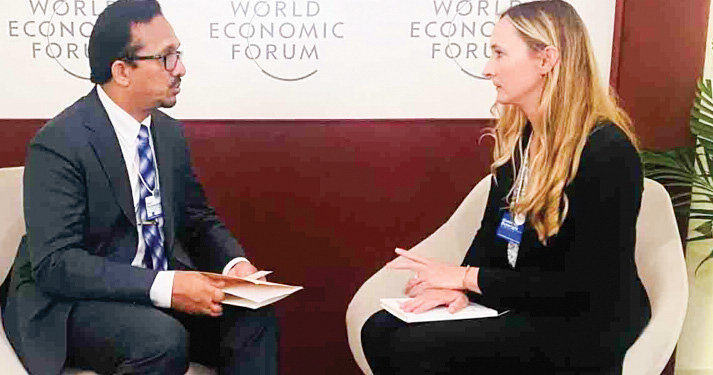
When Minister Sunil Handunnetti addressed the World Economic Forum’s ‘Is Asia’s Century at Risk?’ discussion as part of the Annual Meeting of the New Champions 2025 in June 2025, I listened to his presentation carefully and to the questions that were posed to him. The trolls that followed and the extremely negative reactions on his use of English was so annoying, arrogant and distasteful that I opted not to comment on it or even privately discuss it at the time. The noise that followed also meant that a more meaningful conversation based on that event on the utility of learning a powerful global language as well as how our politics on the global stage might be carried out more successfully in that language was lost except in a few exceptional commentaries. But now, Handunnetti has reopened the conversation, this time in Sri Lanka’s parliament in November 2025, on the utility of mastering English particularly for young entrepreneurs and makes a plea at one point not to mock his struggle at learning English given that he comes from a background which lacked the privilege to master the language well in his youth. His clear intervention makes much sense while his silences also speaks volumes.
And yet again, the same clowns who ridiculed him when he spoke at WEF are laughing at him yet again on his pronunciation, incomplete sentences, bringing shame to the country and what not. As usual, such loud politically motivated and retrograde critics miss the larger picture. Many of these people are also among those who cannot hold a conversation in any of the globally accepted versions of English. And their arrogance on the so called ‘correct’ use of English seem to suggest the existence of some ideal English type when it comes to pronunciation and basic articulation. I thought of writing this commentary now in a situation when the Minister himself is asking for help ‘in finding a solution’ in his parliamentary speech even though his government is not known for critical reflection from anyone who is not a party member.
But the speech at the WEF and in Sri Lanka’s parliament in more recent times are two very different things though both are worthy of consideration, in the realm of rationality and not in the depths of vulgar emotion and political mudslinging.
The problem with Handunnetti’s presentation at WEF was not his accent or pronunciation. After all, whatever he said could be clearly understood if one listened carefully. In that sense, his use of English fulfilled quite well one of the most fundamental roles of language, which is communication. Its lack of elegance coming from someone who does not use the language professionally or personally on a regular basis was a natural outcome which should not be held against him. But there are many issues that his speech flagged that were lost in the noise meant to discredit him.
Given that Handunnetti’s communication was clear, it also showed much that were not meant to be exposed. He simply did not respond to the questions that were posed to him. More bluntly, a Sinhala speaker can describe the intervention as යන්නේ කොහෙද? මල්ලේ පොල්, which literally means when one is asked ‘where are you going’, the answer comes as ‘there are coconuts in the bag.’ He spoke from a prepared text which his staff must have prepared for him. But it had nothing to do with what was being directly posed to him. The issue is that same staff seems to have not coordinated with the Forum organizers on the nature of questions that would be posed to the Minster or provided on their own what questions should be posed to him for which answers could have been provide for him based on both global conditions, local situations and government policy. After all, this is a senior Minster of an independent country and has the right to know and control, when possible, what he is walking into in an international forum.
This is routine in this kind of international encounter, and all this was possible within reasonable limits. It is unfortunate that his staff did not do the homework that was required and obviously the minister himself did not follow up. This shows both lack of preparedness and lack of experience among all concerned. On the other hand, the government needs to have a policy and practice who it must send to such events. For instance, should a Minister attend such events, or should the government be represented by an official or consultant who can speak fluently and with authority on what is asked. That is, such speakers need to be very familiar with the global issues concerned and not mere political rhetoric meant for local audiences that is more useful in the local public rally and television discussion circuits. Other than Handunnetti, I have seen, heard and heard of how poorly our politicians, political appointees and even officials perform at international meetings (some of which are closed door) bringing disastrous consequences to the country, over which none of them take responsibility.
Such reflective considerations are simple but essential and pragmatic policy matters on how the government should work in these conditions. If this was done, the WEF event might have been better handled with better global press for the government. On the other hand, this was not only a matter of English. For one thing, Handunnetti and his staff could have requeued for the availability of simultaneous translation from Sinhala to English for which pre-knowledge of questions would have been useful. This is what president Dissanayake did at the UN in the recent past, in the Sinhala language, when he made a decent presentation. Not ground breaking, but decent. Also, if he had the ability express in Sinhala, would things have been any better? Very unlikely I think, barring fluency of language use. This is because Handunnetti, like most other politicians past and present, are good at rhetoric and not much on substance particularly when it comes to global issues. This becomes obvious all the time. This is why such leaders need competent staff and consultants and not mere party loyalists and yes men and women to surround them as is the case at present, which is an unfortunate situation that has engulfed the whole government.
But what about the parliament speech? Again, as in the WEF event, his presentation is crystal clear and, in this instance, contextually sensible. But he did not have to make that speech in English at all when decent simultaneous translation services are available in parliament. But in so far as content was concerned, he made a sensible argument considering local conditions which he knows well. The Minister’s argument is about the need to ensure that young entrepreneurs be taught English so that they can deal with the world and bring investments in to the country, among other things. This should actually be the norm, not only for young entrepreneurs, but for all who are interested in widening their employment and investment opportunities beyond this country and in accessing knowledge which simply cannot be done through Sinhala and Tamil alone. To me, Handunetti’s argument is important because when it comes from him in parliament, it can be read as a policy prerogative. He asked the Minister of Education to make this possible in the educational reforms that the government is contemplating.
He also asks his detractors not to mock his struggle in learning in English and become part of the solution. I personally don’t think this is the kind of chip that the Minister need not carry. Why should he be concerned about people who will mock whatever he does and say on English and in English? But there is a silence that is plea does not address which I wish was also addressed. That is, what prevented him from mastering his English in his youth is not only a matter of his background lacking in privilege. It is also because the facilities that were available in schools and in universities were not taken seriously and often looked down upon as kaduwa by the political spectrum he represents and nationalist elements for whom the utilitarian value of English was not self-evident. This was a considerable part of the reality in my time as an undergraduate and throughout the time I taught in Sri Lanka. This is also why, swayed by the rhetoric of Sinhala language nationalism my own mastery of English was got delayed even though my background is vastly different from the Minister. But I was mocked too when two important schools in Kandy refused to admit me to Grade 1 in primary school as my English was not good enough. This was nearly 20 years after Independence. But I did not carry it as a burden on my shoulder but mastered it though I possibly had better opportunities and saw the nature of the world vastly different form the Minister. If his commitment was also based on these social and political realities and the role people like him had played in negating our English language training, I think his pela would have sounded far more genuine.
If both these speeches and the contexts in which they were made say something about the way we can use English in our country, it is this: On one hand, the government need to make sure it has a pragmatic policy in place when it sends people for international events which takes into account both a person’s language skills and his breadth of knowledge in the concerned area of interest. On the other, it needs to find a way to ensure that English is taught to everyone successfully from kindergarten to university as a tool for inclusion, knowledge and communication and not a weapon of exclusion as is often the case now. But this can only be done well if the failures, lapses and strengths of the country’s English language teaching efforts are seriously taken into consideration. It is unfortunate that division and discrimination are still the main emotional considerations on which English is still being popularly used as the trolls on the Minister’s English use after both events have indicated. These small-minded individuals do not seem to realize that the Brits have long lost their unquestioned ownership over English along with the Empire itself. It is now mostly ours, the way we use it and not simply theirs.